by Modern Songbook Records | Apr 12, 2013 | Charlie's Blog, News
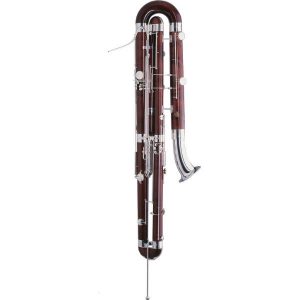 If you’re a composer, there is a moment when you are laying out ideas for the first movement of an orchestral piece that has serious consequences for all the following movements. You must decide whether you want to use a contrabassoon. Or a bass clarinet. Or a piano. Decisions like this can affect who will eventually play, or even look at, your piece.
I’m told there is nothing more infuriating to a conductor than finding out that the composer has written for contrabassoon for only one movement–and that the part is crucial to the overall feeling of the score. This means that the other movements will feature a fully paid contra player sitting on his hands in the woodwind section. For most of the orchestras that play my work, this is a couple hundred bucks that could be used for something else. I have learned my lesson: I don’t include a supplementary instrument in a piece unless I am going to use it throughout.
As for piano, I have found that most rehearsal halls for community orchestras do not have pianos, and that many concert halls have horrible pianos. Including piano in your score–no matter how Copland-y you are feeling–could preclude having the piece chosen for a performance. You are generally better off writing for marimba or harp.
I resisted using Sibelius notation software at first. I was very happy with my Judy Green score paper and Judy Green pencils. But the software has some features that help me keep music directors happy. Chief among them is the program’s strong preference for consistent orchestrations in a piece. If you try adding instruments midway through, you are asking for a world of trouble. Ten years of Sibelius–and even longer working with the conductors of academic, regional, and community orchestras–has made me a better, more consistent, and more user-friendly composer.
by Modern Songbook Records | Apr 5, 2013 | Charlie's Blog, News
Starting an album is easy. Finishing it is hard. After some really fun and completely exhausting work, we’re done recording and mixing the next Chaise Lounge CD. The album, Dot Dot Dot, features some of our most-requested songs, including “The Coolest Car,” which has already been played on NPR’s Car Talk, and “My Losing Streak,” a show-stopping instrumental featuring our sax player, Gary Gregg. Along with nine of my originals, the CD includes covers such as Leonard Bernstein’s “Cool” and a terrifyingly fast version of Jerome Kern’s “Old Man River.” The album should be making its way onto record store shelves by mid-May. Oh wait…there aren’t any more record stores. But you’ll be able to find the CD at chaiseloungenation.com.
by Modern Songbook Records | Mar 29, 2013 | Reviews

Playing piano for Gia’s show is one of the great pleasures in my life. Here is a recent review from Cabaret Scenes:
Stardust twinkled down at the Gardenia during Gia Mora’s show, and I don’t mean just because she included that Hoagy Carmichael/Mitchell Parish song in the act. Mora is the complete package—great voice, songwriting ability, humor, intelligence, looks and imagination. The unique theme was “The science of love…theoretically speaking.” “Love” was dealt with on two fronts: Mora’s love and passion for science and examining love through science. Subatomic particles, the Big Bang Theory, history of the universe and other scientific matters were cleverly tied to the search for, glories and disappointments of love.
She set the tone right off the bat with her own witty song, written with Brad Brown, called “E=MC2.”The history of the universe was covered with her lyrics and Mozart’s music in “March of the Quarks.” Oh, how I wish my science teachers had presented this material in such an appealing manner.
Her repertoire mixed standards, like “What a Little Moonlight Can Do,” in which she demonstrated her scatting ability, with contemporary social-media songs, such as another Mora original, “Missing David B.-w4m-41” (dealing with missed connections on Craigslist) and Kate Miller-Heidke’s “The Facebook Song.”
This show was a joy from start to finish, and marks the start of that stardust coalescing into a star.
by Modern Songbook Records | Feb 25, 2013 | Charlie's Blog, News
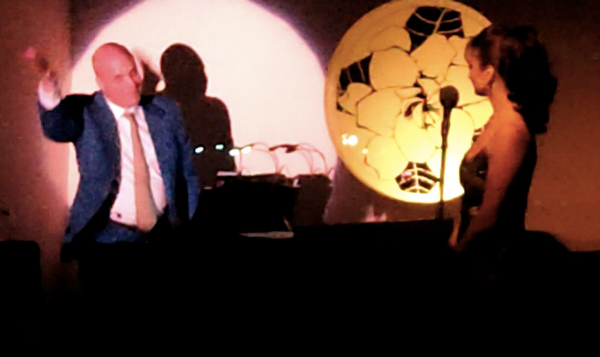 Gia Mora and I just played a couple of gigs in LA. She has a cabaret show called “Einstein’s Girl.” It combines some spectacular singing (hers), some unexpected song selections (e.g., “She Blinded Me with Science”) and Gia’s passion for astrophysics. It is an amazing piece of whatever it is…performance art, cabaret, stand-up science? But the two shows illustrated the sometimes-stark contrast between how a gig plays on Facebook and in your mind, versus how it plays out in real life.
The first gig was at The House of Blues. It is an amazing venue on Sunset Boulevard. It is the house that Dan Akroyd built out of vodka, voodoo, Persian rugs and outsider art. I loved posting our performance there on Facebook. In my mind, this couldn’t have been any cooler. But the reality of the gig was something else again. It started with a rock-and-roll sound guy who did not get what we were doing at all. There was a smallish crowd of hipsters—a bobbing swarm of hats and tattoos—who were largely uninterested in what we were doing. It hit me just fifteen minutes too late that this was not a listening room at all. This was a club with an entirely different agenda from mine. We played our set, and when it was over we felt worse about music than when we started. But—and this is a crucial “but”—it was great to say that we played the House of Blues.
Two days later we played a little club called The Gardenia. It is on Santa Monica Boulevard between La Brea and Sycamore. It has been there for thirty years. And it must look exactly the same as when it was first built: a bland “L” shaped room with seating for 80, max. There is a piano and a few mics and two ancient Ramsa PA speakers. The only thing that gave me a clue of what was to come was the lighting: a real theatrical spotlight in the back, theater lighting on the ceiling, and the LED standlights on the piano.
Our sound check was at 3 pm for a 9 pm show. The lighting tech and sound tech were the same person, Shauna. There was so much right, so soon. Shauna was a total pro. She knows her room and understands sound and lighting. The sound check involved mostly lighting cues. I loved this. The “sound” part of the sound check only took five minutes because Shauna determined that the piano was going to be loud enough without any amplification. How many sound techs will turn a mic off? Very few. She instinctively knew two things right away: One, that the balance would be OK and two, that the natural sound of the piano would be better than the amplified sound of the piano. Beautiful. The “lighting” part of the sound check gave Gia and me a chance to go over the beginnings and ends of all our songs while Shauna made notes about lighting changes, gel choices, blackouts, etc. I can’t stress enough how important effective lighting is in any presentation. Any theater person knows this. But so few music clubs seem to understand it.
The show later that night was terrific. Gia was totally on. I think I can say that I played really well. The club was completely full of appreciative fans who love Gia and love this style of music. It was a grand night. But when I talk about last week’s trip to LA, I will always start it with this: “I was in LA to play at The House of Blues…” It just sounds so good.
by Modern Songbook Records | Jan 17, 2013 | Charlie's Blog, News
One of the best things about living in Washington DC is New York. If you have the great foresight to live anywhere in the BosWash corridor, you get New York as part of the deal. It is just a bus ride away. Or a train ride; or a relatively short auto trip. I feel lucky in that I can walk to the Vamoose bus stop and four hours later get off at Madison Square Garden. There are parts of the day when it would take me that long to drive to Alexandria.
I went up to NYC on the Vamoose bus yesterday. My daughter and I had dinner in the East Village at Supper (excellent food! N.B. cash only). Then we walked down to the corner of 2nd St. and Avenue C to The Stone, a club started by composer/arranger/producer/player John Zorn. They don’t advertise. They don’t serve food. They don’t serve drinks. It is all about the music. We saw an avant-garde string quartet called the JACK Quartet with composer Derek Bermel joining them on clarinet. First, they played a challenging piece of Bermel’s: challenging to play and even more challenging to listen to. “Adventurous” doesn’t even come close. And then they played a Brahms quintet. I hate Brahms, so musically that was something of a bust for me. But being in the coolest club in all of New York trumped anything musical. The place only held about 50 people, of whom 50 knew who the JACK Quartet was, and 48 knew who Derek Bermel was. There was a sense of exclusivity to the concert. We were suddenly part of “something”—something current and viable and exciting. I felt smarter for just being there. There is a lot of great music being made in DC right now, too, but I love having New York at the end of my neighborhood.