Thanks to critic Kathy McAuley for her kind and clever writeup of our Allentown table read of The Last Days of Cleopatra.
“It was all over the top – sort of like a party,” actress Sharon Ferry told McAuley. “I liked the sense of fun; it was so spirited, no subtlety, just flat out fun.”
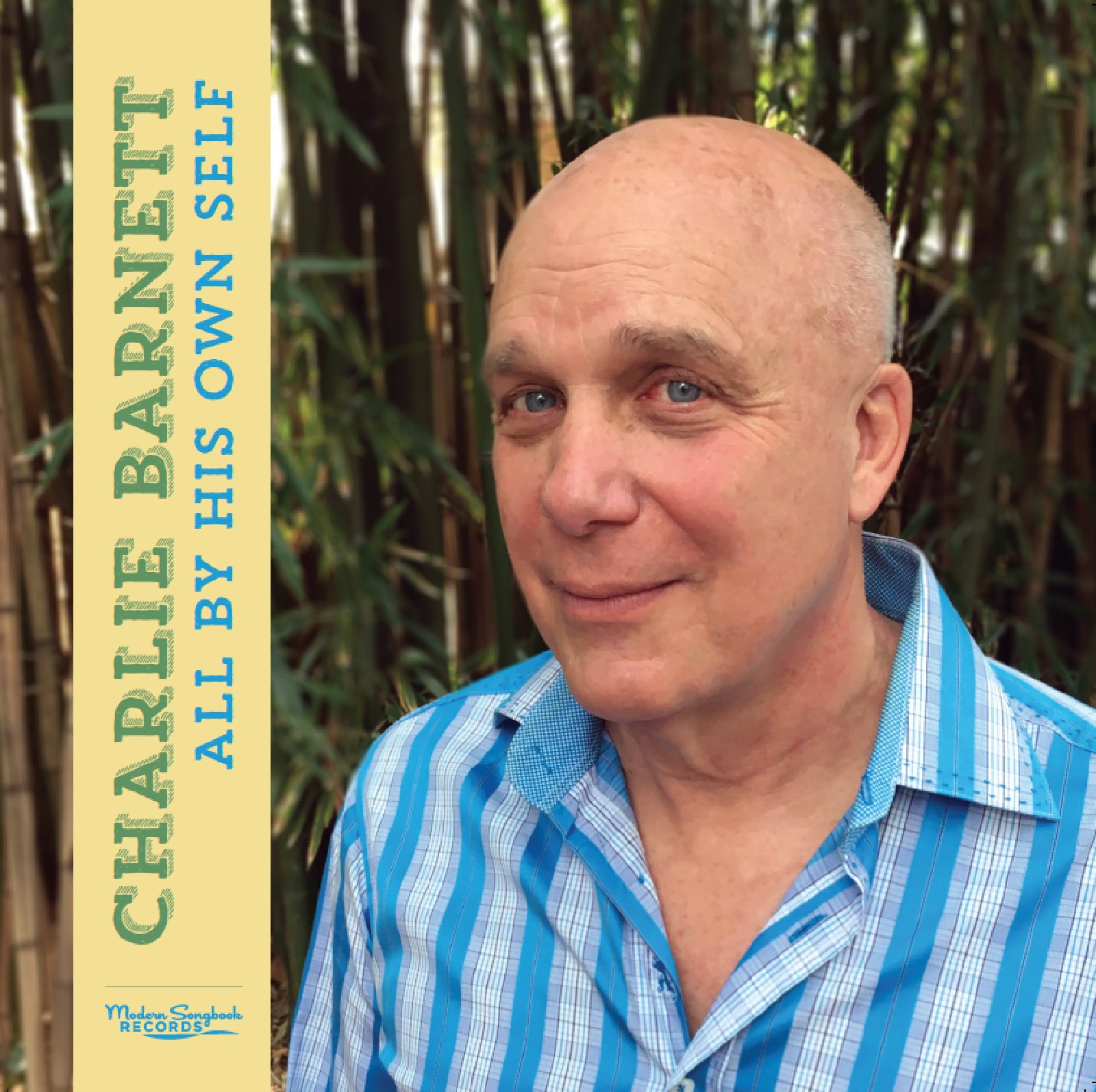
So here’s an unexpected development: My new solo album is on the FAI Folk Chart for August! “All By His Own Self” is #17 on the album chart; two songs from the album are on the song chart (“Hold Still” at #16 and “Corinna, Corinna” at #22); and I am #24 on the “Top Artists” chart.
If you’d like to hear selections or buy the album, you can find it at my online store.
Yes I know this is from more than two years ago. But we are all living in some sort of aboriginal dream time right now. So I might as well post this. I love the line in this: “Reader, I play bassoon.”
12ness – Theatre Review June 11 2017
It’s been a weekend of enjoying more art “Made in Bethlehem.” Friday night at Godfrey Daniels, I was soaking in the “front porch” feel of good ol’ folk music by Tom and Betty Drunkenmiller with Norm Williams. It was a perfect night for some laid back classics and good stories. I was feeling a bit too much of a summer cold to enjoy any fun on Saturday (especially the Food Truck Boarder Brawl at ArtsQuest), but grateful to feel better to take in a play at the Ice House this afternoon.
Local theatre company, Crowded Kitchen Players premiered an original piece written by local playwright, Charlie Barnett. The play was directed by Selkie Theatre’s George Miller.
12ness is a play that recounts the historical relationship between two influential musicians, Arnold Schoenberg and George Gershwin. The play features wonderfully written dialogue that sounds as natural as if the audience were secretly transported in a time machine to 1937 Los Angeles.
The minimal sets, vintage costumes, and sound design also brought a touch of classic Hollywood that helped the audience sink back in time and get to know the characters even without too much “scholastic” knowledge.
I’ve studied lots of music history, required of my academic music degrees. But it’s not a requirement to know those details to thoroughly enjoy the relationship between the four characters. Yet, all of that knowledge that was crammed into my head for the doctoral comprehensive exams came leaking back to the front of my brain and I was able to catch most of the references to the number 12, and a few double reed jokes seemingly written with full knowledge of the quirky personalities that result from too much air pressure. (Reader, I play the bassoon.)
If you go, here would be my comments to put more context into some of the text:
12 tone composition (Dodecaphonic) was designed by Arnold Schoenberg. Otherwise known as “serialism,” a method of composing where notes only relate to each other. 12 tone uses all of the half steps within the octave. Schoenberg came to this way of constructing music after sensing that traditional western harmonic structure had pretty much played itself out. Think about the really long lines of a Wagner theme, and you might understand how the listener can lose the sense of tonal center. It was highly intellectual music; order, form, and function of a serial application also extended to length of note, or sometimes dynamic.
There is a reference to the word “atonal” in the play. Listeners might apply this word to serial / 12tone music in that there is no tonal center typical of western music, such as in the key of B-flat. That doesn’t mean there’s no “tone” to the music.
George Gershwin was at the height of his career in 1937; the same year he died from a brain tumor.
In looking for some ideas for this review, I found this 1 minute comment about Gerswhin by Schoeberg himself. The video features a still image of Gershwin painting Schoenberg’s portrait. If you are so moved, stick around for the video that follows. It’s silent home movie shot by Gershwin, accompanied by Schoenberg’s String Quartet.
The play doesn’t just focus on music. The play also shows how they may have talked about art, the senses, and the creative process. If you ever wonder what artists might be thinking about the way they create, or how they perceive value of their work – this play is a fabulous conversation starter with friends.
12Ness runs for another weekend at the Bethlehem Charles Brown IceHouse, 56 River Street, near the Wooden Match or Artisan. Make a night of it with dinner at any of the lovely restaurants on Main street before hand. Performance begins at 8pm on Friday, June 16 and Saturday, June 17th. The final show is Sunday, June 18th at 2pm.
Notes for further inspiration:
There have been a few academics who have presented research on the relationship between these two composers. This play offers an imagination into their conversations about art. What I found so wonderful, is that these kinds of conversations happen today. Robert Wyatt & John Johnson wrote a book, “The Gershwin Reader” that includes a chapter about this friendship. There happens to be copies of this book in the libraries of all six independent colleges in the Lehigh Valley. I think the next time I go strolling through the stacks, I’ll seek this out.
There is a copy of “Shall We Dance” at the Bethlehem Public Library. I just might pull that one out for a spin.
An entire book shelf fell down while I was cleaning today. After all, what else are we doing with our time these days.
And a review from Fanfare, a mostly classical music oriented magazine dropped on my head. I’ve never posted this before, I guess because I didn’t have a website in 2009. Anyway it is a nice review of Chaise Lounge’s Second Hand Smoke CD ( our second. We are working on number eleven now!) Thank you Raymond Tuttle for the nice words. You can read it by clicking here: Second Hand Smoke Review in FANFARe by Raymond Tuttle
For Jennifer Schwed, Election Day 2016 brought the full gamut of emotions.
Like many women across the country, she woke up the morning of November 8, 2016 in a state of expectant elation—fueled by the belief that our nation was on the cusp of electing its first female president. Instead, when she went to bed that night, Donald Trump, a self-avowed sexual predator who routinely denigrates women, was slated to move into the White House.
As she shook off the shock and disbelief, Schwed decided that an America that could elect Donald Trump as president, was an America that didn’t care about women. She decided to table her long-simmering idea of producing a musical about how women fought—and won—the right to vote.
And then the Women’s March happened. Standing between the Capitol and the Washington Monument—part of an infinite mass of well-bundled men, women and children wearing pink hats and carrying signs with messages like “A Woman’s Place is in the Revolution” or “This Pussy Grabs Back”—Schwed changed her mind.
“I realized that these are exactly the stories that need to be heard,” she said.
She proposed the idea to her business partner Doug Bradshaw—and he pegged it “19.”
More than three years later, 19: The Musical is a two-hour musical that chronicles women’s struggle to gain the right to vote—which was finally won a century ago with the 19th amendment to the U.S. constitution. Modeled after Hamilton, 19 brings to life a story that few Americans know or understand.
The main character is based on Alice Paul, one of the key leaders of the women’s suffrage movement.
“I couldn’t believe that I didn’t really know who Alice Paul was. Turns out, very few people seem to know who she was,” said Bradshaw.
19 also incorporates the perspectives of Ida B. Wells, Susan B. Anthony, Carrie Chapman Catt, Inez Milholland and others. However, with existing historic material on suffrage in America that is both sprawling and contradictory—Paul herself, unlike Alexander Hamilton, kept very few personal records—Schwed and Bradshaw decided that it would be extremely difficult, if not impossible, to portray a strictly factual account of the movement. They opted instead to occasionally use composite characters or scenes to depict certain relationships and major themes, to move the action along or to give the audience the big picture.
“There are so many conflicting stories, one contingent will say, ‘No it happened this way,’ the other will say, ‘No, it happened this way,’” Schwed said. “There is no one bible of history on suffrage and how these things went down.”
Schwed and Bradshaw—who together founded Through the Fourth Wall, an award-winning theater, film and interactive digital media company—have collaborated on many productions over the years. 19 is their most ambitious to date—and their first musical.
They knew they needed a composer: a third partner who would play a crucial role by writing and producing the music to match their lyrics. They set out in search of a female composer who was well-versed in 1920s jazz. Schwed posted a message to a listserv for women in film and video. Her first response came from composer Charlie Barnett, who happened to be a man.
“I think I’m your guy,” he told Schwed. He later admitted laughingly to not being “a close reader of ads.”
“He’s a brilliant musician,” Schwed said. “And while I originally wanted more women involved with 19, there’s something to be said for men to be excited and interested in elevating it too.”
The threesome got to work writing the script and the songs.
“It’s a genre stew,” Barnett noted. “We’ve created 50-60 songs; we’re on version 15 of the script. Some really good songs ended up on the cutting room floor. As the script evolved, so did the songs. As much as I am a completionist at heart, I had to accept the malleability of this thing, always in flux, always ready to be redone, rewritten, rethought over.”
They then recruited the cast: 19 women and two men, many of whom have stayed with the production from the beginning. Karen Bralove is the oldest cast member at 74.
“If you commit to two years of unpaid rehearsals and a constantly changing script, you’re obsessed,” Bralove said. “I was obsessed with the story of these women. In 1920, my grandmother was alive and she got to vote; my mom was seven years old. I touch history.”
Beginning in late 2017, they began workshopping 19 with more than 30 performances around the Washington, D.C. area. With Barnett on the piano, Schwed and Bradshaw attended each performance. Together, they all held question-and-answer sessions afterwards to elicit audience feedback.
One of the hardest parts to portray was the chief internal conflict that roiled the movement—incorporating women of color. They ended up creating a heated discussion between Paul and Ida B. Wells, an African-American journalist, abolitionist and feminist, about whether or not they would integrate a 1913 march for the vote in Washington. The discussion became the show’s most popular song, “Put Yourself in My Shoes.”
“We knew there was massive racism in the movement,” said Bradshaw. “But as far as we know, Ida never walked into Alice’s office and spoke to her, we completely made that up.”
In the show, Paul argued against integrating the march because Southern white women threatened to boycott if African-American women were allowed to march alongside them. They wanted women of color segregated and walking in the rear. Wells argued for integration because the women’s suffrage movement was about gaining the right to vote for all women. And, as she noted, African-American women were fighting for more than the vote: They were fighting for their lives.
The song begins in Paul’s voice:
“Put yourself in my shoes; we have no time to lose. Only one more shot to change this plot and win the prize for which we’ve fought so hard. Put yourself if my shoes.”
Wells then takes over:
“Don’t talk to me ‘bout your pain. You’ve never seen loved ones slain. I won’t be denied, ignored or pushed aside.”
The song ends with the two of them singing together:
“Put yourself in my shoes. We have no time to lose.”
For Schwed, talking about racism was always an important part of telling the movement’s story.
“This was never meant to be strictly a celebration of the movement,” she said. “When women are talked about they are either perfect or evil. I wanted to walk in the middle of that and say they were human, they were fallible, they made mistakes.”
The show also portrays the beatings, forced feedings, arrests and imprisonment that the women of the suffrage movement endured.
“It’s very emotional,” Bralove noted.
The first full performances of 19 were held at the National Museum of Women in the Arts in November 2019, in front of sold-out audiences. Now, the production goes to New York in search of investors, producers and theater companies interested in staging it. Schwed, Bradshaw and Barnett all believe that the show can teach important lessons about history and women’s continued fight for equality.
“2020 is just the coming out party of the show. We think it should go on for a long time,” Bradshaw said.
Barnett would like to see it become a show performed by high schools across the country.
“It’s the perfect message for what every high school in America should be putting on,” he said.
Throughout the three years of writing, producing, revising and performing—all while maintaining day jobs to pay the bills—Schwed has kept a vision in her mind of the women of the suffrage movement under ice. She believes that 19 is allowing that ice to begin to thaw, bringing new life to the suffragists and their stories.
“The good part and bad part about the show is that it’s relevant,” she said. “The struggle continues.”
Emilie Surrusco is the founder of Ellsworth Media Group, where she works with organizations and individuals fighting to move a progressive agenda in Washington, D.C. She previously served in a variety of non-profits as a communications specialist, including roles as Speechwriter at the American Bar Association and Press Secretary at Feminist Majority Foundation.
By Ann Hornaday Movie Critic
Jan. 31, 2020 at 7:00 a.m. EST
Can cinema break us out of our silos?
That question occurred to me recently when I watched “Created Equal: Clarence Thomas in His Own Words,” a new documentary about the notoriously taciturn Supreme Court justice who, over the course of nearly three decades on the bench, has rarely asked a question during oral arguments. As “Created Equal” demonstrates, when Thomas decides to talk, he’s undeniably compelling. In the film, the 71-year-old judge recalls his early youth in Pin Point, Ga., and the harsh life lessons he received at the hands of his uncompromising grandfather in Savannah. He revisits the betrayal he felt at the bigotry of his fellow Catholics during a brief stint in the seminary before moving on to Holy Cross and Yale Law School. By the time “Created Equal” gets to Thomas’s confirmation hearings for the Supreme Court in 1991 — when he was accused of sexual harassment by law professor Anita Hill — Thomas has completed a startling transformation. Having become a revolutionary black nationalist in college, he identified as a Democrat and “lazy libertarian” before becoming a strict conservative. Today, he is still wounded and enraged by American racism, even though he sees the standard liberal response to it as patronizing and hypocritical.
Let it be noted: I am not the core audience for “Created Equal.” I abhor many of Thomas’s opinions on the court, particularly regarding reproductive rights, gun control, voting access and campaign finance. I was angry when it was revealed that the all-white, all-male Senate Judiciary Committee led by Joe Biden in 1991 chose not to hear public testimony from witnesses who might have corroborated Hill’s story. I’ve been dubious of Thomas’s silence during Supreme Court proceedings, chalking it up to disinterest, insecurity or petulance. Like my colleague Michael O’Sullivan, who reviewed “Created Equal,” I wish the film had probed more deeply into the particulars of his intellectual evolution and challenged the most self-justifying aspects of his narrative. But, even with those misgivings, I enjoyed “Created Equal,” and not only because of the “Garbo talks!” novelty of hearing the Quiet Justice speak (the two-hour film was culled from more than 30 hours of interviews). Thomas’s life story is riveting, from its roots in the Gullah culture of coastal Georgia to intergenerational psychodrama worthy of the ancient Greeks. Although I hadn’t changed my views of Thomas’s opinions by the time the movie ended, I felt I at least understood the man and his contradictions far better than when it began. And that made encountering “Created Equal” on its own terms a worthwhile, even rewarding exercise. I thought back to “RBG,” the adoring documentary about Ruth Bader Ginsburg that became the hit of the summer in 2018, and 2014’s “Anita,” about Hill’s career-long fight for gender equity. If I could accept those uncritical films of two women I already admired, why shouldn’t I be able to find value in a similarly one-sided portrait of someone with whom I vehemently disagree?
Supreme Court Justice Ruth Bader Ginsburg was the star of her own adoring 2018 documentary. (Michael Robinson Chavez/The Washington Post)
Make no mistake: “Created Equal” is a one-sided portrait. The film’s director, Michael Pack, is a longtime conservative filmmaker, whose documentaries include “Hollywood vs. Religion” and “Inside the Republican Revolution,” and who led the right-leaning think tank the Claremont Institute for two years. We first met in 2000 when he brought his film “The Fall of Newt Gingrich” to the Maryland Film Festival; in 2017, we engaged in a public conversation at AFI Docs, discussing ideological diversity within the nonfiction filmmaking community. I have remained friendly with Michael and his wife, Gina Cappo Pack (executive producer of “Created Equal”), ever since. Even without knowing the Packs, I would consider “Created Equal” a success, starting with the subtitle. From the outset, viewers are put on notice that the story they’re about to hear is solely from Thomas’s point of view (the only other voice in the film belongs to Thomas’s wife, Virginia). And that makes a difference. Rather than purport to be an objective, journalistic report, “Created Equal” makes it clear that this will be a highly sympathetic account of its subject — a safe space in documentary form. Thus situated, I was able to watch with the appropriate filter, appreciating the fascinating personal and social history that weaves through Thomas’s biography while taking issue with his most frustrating, even infuriating pronouncements. It’s just this kind of compartmentalization — figuring out what you accept, reject, are surprised by or simply want to file away for further study — that defines critical thinking, a skill that has become virtually extinct in a hyper-polarized culture. Can cinema be a depolarizing force? Back when movies were projected in dark rooms full of strangers, we lowered our defenses to enter a kind of shared dream state. That communal experience might be increasingly obsolete, but even taking in Thomas’s storyon a laptop forged a far more powerful connection than would have been created by the intellectual exercise of reading his memoir, or an op-ed. You can toss a book across the room, or click away from an article you don’t like; movies are different, in that they operate both as a delivery system for information and as an emotional medium. Even as I mentally picked apart the film’s most objectionable assertions, the ways Pack used Thomas’s voice and the imagery from his past forced me to sit with the man and his story, and to contend with the paradoxical feelings — compassion, admiration, surprise, deep skepticism — that surfaced as a result. I discovered that even passionate disagreement can coexist with edification, however uncomfortably. Of course, film’s ability to short-circuit rationality is precisely what makes it such a potent — and potentially dangerous — medium. But it’s also what makes film an ideal venue for encountering ideas and experiences diametrically opposed to our own. That doesn’t mean that the act of watching a movie is equal to tacit agreement or that buying a ticket confers endorsement. But it does mean entering a good-faith contract between filmmakers, who must be as scrupulously transparent as possible, and audiences, who vow to remain open-minded and critically engaged. When those conditions are met, cinema gives us the best chance possible to lay down our arms, open our minds, and — just maybe — shut up and listen.
On the day I was to see 19: The Musical—which is about how the amendment granting women the right to vote came to pass in 1920—our Constitution Denier in Chief made a perfectly timed gaffe. There he was at his Oval Office desk surrounded by women who had come to watch him put his Sharpie to the Women’s Suffrage Centennial Commemorative Coin Act—a bill that would direct Treasury to mint a special one-dollar coin (which had worked out so well for Susan B. Anthony).
Upon signing, a stumped Trump asked in all seriousness: “I’m curious why wasn’t it done a long time ago?”—the meaning of the word centennial apparently out of reach of his brain. Then, in all self-servingness: “I guess the answer to that is because now I’m president, we get things done.”
19: The Musical has a presidential character nearly as alarming a buffoon: the pompous Woodrow Wilson (Brian Lyons-Burke in top hat), who famously stalled women’s suffrage and jailed and tortured suffragists. At odd moments the musical has him muttering to anyone in earshot, “Mansplain, mansplain, mansplain.” He may be historically a dick, but here he’s the butt of the joke.
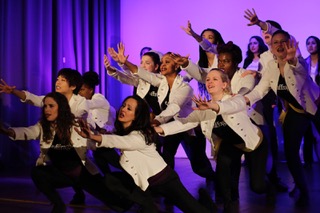
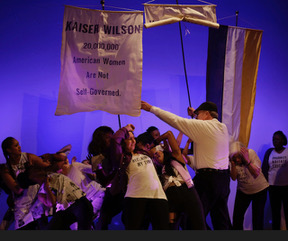
Suffragists in a scene from ’19: The Musical.’ Photo by John Meyers.
For nearly three years, Jennifer Schwed and Doug Bradshaw (book and lyrics) and Charlie Barnett (music) have been collaborating on a musical that would popularize the much-ignored story of the courageous women who fought for decades against a system stacked against them to get the right to vote. The idea was to have it ready by the women’s suffrage centennial next year. Notable figures in this struggle—such as Alice Paul, Lucy Burns, Carrie Chapman Catt, and Ida B. Wells—would be brought to life in scenes and show tunes together with a chorus of dancers and singers.
Dancers Becca Weiss, Angela Norris, and Danielle Marquis in ’19: The Musical.’ Photo by John Meyers.
Portions of the work in progress have been presented in more than 30 workshop productions. I reported on one at 1st Stage last January, which was when I first recognized not only the outstanding songwriting gifts of the creators but also the enormous challenge they had undertaken: to reconcile the requirements of a song-and-dance Broadway-style musical with the underlying gravitas and hostility in the history of women’s suffrage, which in fact had taken a punishing path to its happyish ending. Now aptly at the National Museum for Women and the Arts (though on a small stage not well equipped for live theater), the full two acts with book intact had their world premiere, and the creators’ material could be appreciated more clearly—even when at times the execution got in its way.
The musical begins at the end, right after the 19th Amendment has passed, with an opening number that is inspired. The stage fills with women wearing black-and-white T-shirts that say Suffragist and singing a lighthearted ditty to a tune you could do the Charleston to, “19 (We Won).” It’s about how inequality “will soon be over”:
The 19th Amendment makes our gender ascendant!…
Our fight for equal rights is done!…
We should have equal pay within the year!…
This witty sendup of over-optimism, accompanied by over-ebullient choreography, gets the show off to a smart start. You just know a reality check is coming. Indeed, a savvy apparition appears—Susan B. Anthony, who in history did not live to see suffrage but who here as “Sue B” (Brenda Parker) warns the revelers in song that it’s not going to be “Easy.”
Scene from ’19: The Musical.’ Center: Brenda Parker (Susan B. Anthony). Photo by John Meyers.
We next meet a central figure in the struggle, Alice Paul, here nicknamed “AP” (Katie Ganem), who sings a beautiful ballad as a letter to her Mother (Karen Bralove) about her aspirations for equality and freedom (“Dear Mama”). Her fierce determination will lead a movement (and, coincidentally, propel the musical’s book) with a seriousness of purpose. AP teams up with Lucy Burns (Krystle Cruz) in a winking vaudeville-style number called “Partners in Crime.” Together they launch the National Women’s Party and the stage fills again with singers singing and dancers dancing to a rousing womanifesto, “New World Order.”
This buoying up of spirits will become a musical motif of the show as it turns its attention to the daunting conflicts—both external and internal—that the real-life movement faced.
The first of those conflicts is dramatized with the introduction of Carrie Chapman Catt (Maria Ciarrocchi), whose conservative blouse and skirt reflect her politics (“I’m Prim, So What”). Though Catt’s got plenty of grit (“You best not mess with me!”), she contrasts with the radical activism of AP and Burns (who will later wear a T-shirt saying Feminist AF). Subsequently in the show a tactical difference will divide them: Catt wants a cautious state-by-state approach to women’s suffrage; Paul insists the focus be federal. Here, in another upbeat song-and-dance number, the musical cleverly depicts the stresses and successes of coalition-building toward a common goal (“Two Sides of the Same Coin”).
A visit to London proves a sobering turning point. The American suffragists meet with British suffragists, in the persons of Christabel Pankhurst (Elizabeth Keith) and Emeline Pankhurst (Millicent Scarlett), who had been brutally jailed for public protests. “Power responds only to pressure,” Christabel tells them, meaning power will crack down on dissent. The Americans get the point, which is underscored when foremother Sue B reappears to spur them to civil disobedience: “Don’t make my mistakes… The right is more precious than peace.” Later AP will address a rally of women activists about what the future may hold: “I cannot guarantee you your safety. I cannot guarantee you your life.” And the show as essential feminist civics lesson gets a whole lot more real.
Scene from ’19: The Musical.’ Center: Millicent Scarlett (Ida B. Wells). Photo by John Meyers.
With the introduction of Ida B. Wells (Millicent Scarlett), the show confronts the racism of white suffragists head-on. Born in slavery and raised as a free woman, Wells became an important journalist of the era and was devoted to Black liberation. Here the character functions as the show’s conscience. When a major suffrage demonstration is being planned, AP critically decides that Wells should not march in front, so as not to lose the support of “white Southern ladies.” Several gorgeous songs express Wells’s dismay—and Scarlett’s vocals are powerful—”Will You Be Here for Me” and “Put Yourself in My Shoes,” in which AP pointedly stands her ground. Finally AP decides Wells can march in the rear with the Howard University contingent. “I’ll march where I damn please” is Wells’s response:
Don’t talk to me about your pain… How dare you ask me to wait?… No more can I stand for this privileged equality… Only the Black woman can say when and where I enter.
That last line references the title of a work by the African American historian Paula Giddings, and it’s just one example of the many quotes tucked insightfully into the script. Another is a line the book gives to Alice Paul—”Courage in a woman is often mistaken for insanity”—which was actually what a male shrink said when refusing Woodrow Wilson’s order to declare her crazy.
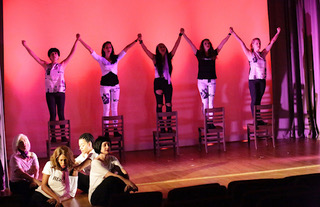
The show includes some very dark episodes in the struggle, indelible reminders of just how brave these women were. In silhouette, backlit by red light, we see women political prisoners who have gone on hunger strike (“Jailed for Freedom”) being forcibly funnel-fed. Similarly in silhouette we see women arrested at a protest being pummeled by cops with billy clubs. “Protest, arrest, release, repeat” goes the refrain of another song-and-dance number (“Release & Repeat”), this time devoid of naive cheer.
During a visit to Wilson’s office, Alice Paul is amusingly met with the aforementioned mansplaining plus musical condescension: “Be a Sensible Girl,” he sings, backed up by a bouncy chorus line in polka dots. Preoccupied with a gathering war in Germany, Wilson is unsympathetic to her cause. “La la la” he says, plugging his ears to tune her out. Unimpressed, AP later calls him a “charlatan, fraud, hypocrite.” Only massive public pressure—which included a silent protest at the White House (“Silence”)—was to change presidential and congressional minds. But that pressure came at a great cost for movement sheros, who in 1917 were viciously imprisoned and tortured at the Lorton jail in Northern Virginia. (A museum near the site will open next year.)
Suffragist protesters attacked in ’19: The Musical.’ Photo by John Meyers.
After the embarrassment of that “night of terror,” Congress passed the 19th Amendment, leaving it up to at least 36 of the states to ratify. The nailbiter came down to Tennessee, where the outcome would be decided by the vote of one tiebreaker: Representative Harry Burn (Gregory Scott Stuart). In one of the most amusing and touching scenes, he is schooled by his mother (Scarlett) in the beautiful “Listen to Your Mother”—and he comes around.
There follow more big musical numbers of celebration and empowerment including a “Reclaiming Our Time” chorale and a very moving “My country, ’tis of thee, / Sweet land of liberty, / Of thee I sing…” When near the end Alice Paul reads the actual text of the 19th Amendment, it comes not with the fizzy optimism of the beginning but with deep emotion well earned:
The right of citizens of the United States to vote shall not be denied or abridged by the United States or by any State on account of sex.
Congress shall have power to enforce this article by appropriate legislation.
Suffragists in ’19: The Musical.’ Photo by John Meyers.
19: The Musical reclaims a time when women fought like hell and paid a price so that women today can go to the polls—even if like most white women in America three years ago they vote a racist idiot into the White House. The book is sturdy, the lyrics are skillful, the score is first rate. I’ve listened to and enjoyed the preliminary cast album over and over on Spotify (see link below). It’s terrific.
That said, the show feels long, and the boost-your-spirits musical numbers get repetitive. Worse, the choreography was too show-off-y for this small stage, too cutesy, and did not so much enhance the storytelling as distract from it. At times it was as if Busby Berkley and June Taylor had a quarrel and no one won. The production of this musical needs to trust more the substance of its storyline. There’s too much ingratiating, too much making nice.
The creators are raising funds to do an industry reading in New York for Broadway investors, producers, and directors. My hope for this show is that it secures such professional backing and that its next iteration will be a production conception worthy of the very promising material. (Click here to make a tax-deductible donation.)
Musical Numbers
ACT I
19 (We Won)
Easy
Dear Mama
The Reasons
Partners in Crime
New World Order
I’m Prim, So What
No Matter the Price
Will You Be Here for Me
Put Yourself in My Shoes
Will You Be Here for Me (Reprise)
Missy
The Bloody March
Liberty For Inez
Dear Mama (Inez Reprise)
Two Sides of the Same Coin
Sensible Girl
The War at Home
ACT II
Right Women, Right Time
Dear Lucy
Silence
Release & Repeat
Victory Will Be Mine
Damned if I Do
Release & Repeat (Reprise)
Reclaiming My Time
Night of Terror
Jailed for Freedom
Evolution
Hypocrite’s Tango
Easy (Reprise)
19 (Reprise)
So Close
Listen to Your Mother
Dear Mama/19 (Reprise)
Easy (Reprise)
Reclaiming Our Time (Reprise)
Cast
Alice Paul (aka AP): Katie Ganem
Carrie Chapman Catt: Maria Ciarrocchi
Emmeline Pankhurst / Ida B. Wells: Millicent Scarlett
Lucy Burns: Krystle Cruz
Sue B. Anthony (aka Sue B): Brenda Parker
Christabel Pankhurst / Inez Milholland: Elizabeth Keith
President Woodrow Wilson / Dr. Gannon: Brian Lyons-Burke
Police Chief Sylvester / Representative Harry Burn: Gregory Scott Stuart
Chorus & Dancers: CinCin Fang, Haylee Green, Raquel Jennings (swing), Danielle Marquis, Angela Norris, Reyina Senatus, Katy Sherlach, Elizabeth Spikes, Rebecca Weiss, Katie Zajic
Ensemble: Alexis Primus, Katy Sherlach
Mother / Ensemble: Karen Bralove
Production Team
Jennifer Schwed: Writer/Lyricist/Director/Producer
Doug Bradshaw: Writer/Lyricist/Director/Producer
Charlie Barnett: Composer/MusicalDirector/Arranger/ Piano/Producer
Theatre Review: ’19: The Musical’ by Through the 4th Wall
Productions at National Museum of Women in the Arts
mdtheatreguide.com/2019/11/theatre-review-19-the-musical-by-through-the-4th-wall-productions-atnational-
museum-of-women-in-the-arts/
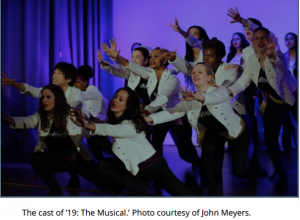
The cast of ’19: The Musical.’ Photo courtesy of John Meyers.
“Witty dialogue, snappy tunes, and imaginative choreography characterize ’19: The Musical.”
As joyful and inspirational as it is, however, the show does not sugar-coat the long and
arduous battle to secure women’s suffrage in the United States.
Beginning with the Seneca Falls Convention in 1848 and culminating in the ratification of
the nineteenth amendment in 1920, Susan B. Anthony (Brenda Parker), Alice Paul (Katie
Ganem), Ida B. Wells (Millicent Scarlett), and other suffrage luminaries tell the story—with
an unflinching look at the sacrifices, obstacles, and setbacks—of the movement to secure
voting rights for half of the American people.
’19: The Musical’ serves as a timely reminder of women’s struggle for full citizenship, a
story we cannot afford to forget it.
A racially diverse cast highlights society’s progress since ratification, but the narrative also
explores the racial tensions that plagued the movement, and snippets of dialogue
frequently allude to the work left to be done to achieve women’s equality. Contemporary
terms such as “mansplaining,” used to describe President Woodrow Wilson’s (Brian Lyons-
1/2
Burke) interaction with the suffragists, give a modern-day spin to a movement that took
place long before equal pay, workplace harassment, or the #MeToo movement flickered
into society’s consciousness.
With humor and deep sincerity, Brenda Parker (Susan B. Anthony) grabs the audience by
the hand and leads them through the tumultuous battle against a world dead-set on
silencing women. Millicent Scarlett (Ida B. Wells) graces the stage with her soaring and
powerful soprano voice, and Katie Ganem (Alice Paul) embodies the uncompromising
determination that drove Paul to withstand multiple arrests, violence, and torture in pursuit
of universal suffrage. Maria Ciarrocchi expertly portrays the uptight and ladylike Carrie
Chapman Catt who naively insists women can “nice” their way into equality by avoiding
tactics that offend those in power.
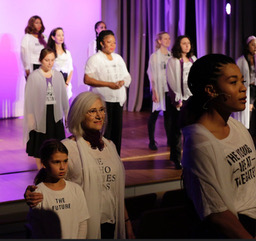
Costumes (Jennifer Schwed) are simple and direct. Women wear white shirts emblazoned
with the word “Suffragist.” Male character’s T-shirts are stamped with the word “Man.” In a
particularly inspiring moment, a young girl appears with a T-shirt reading “The Future.” The
set is as uncomplicated as the costumes, creating a sacred space in which this vital piece of
American history can take center stage.
The show’s composer, arranger, and musical director Charlie Barnett provides the piano
accompaniment throughout the evening, nimbly shifting between high-intensity ballads and
up-tempo dance numbers.
Written and directed by Washington D.C. area natives Jennifer Schwed and Doug Bradshaw,
this musical comes at a crucial moment in our country’s history and in the fight to build a
more just world for all people. “19: The Musical” serves as a timely reminder of women’s
struggle for full citizenship, a story we cannot afford to forget it.
Running Time: Approximately 2 hours and 30 minutes with one intermission.
“19: The Musical” ran through November 27 at the National Museum of Women in the Arts,
1250 New York Ave NW, Washington, D.C. 20005. For information about the show, click
here
From an early stage reading of 19: The Musical. Image credit: Louis Sica
There’s a sculpture in the rotunda of the U.S. Capitol that is often overlooked, but is destined to get an exceptional amount of attention in the coming year. Adelaide Johnson’s monument to women of the suffrage movement depicts three early advocates, Elizabeth Cady Stanton, Lucretia Mott and Susan B. Anthony… as well as an unfinished block of marble behind them which is believed to suggest that the fight for women’s rights also remains unfinished.
The world premiere of a new musical about suffrage, 19: The Musical, calls to mind this sculpture. The U.S. is coming upon the 100th anniversary of the ratification of the 19th Amendment, and women, while they proudly exercise their right to vote, still fight against other disenfranchisements and inequities. Especially in this era of #MeToo, equal rights remains a work in progress.
From an early stage workshop. Image courtesy 19themusical.com
19: The Musical gives a glimpse of the How and Why. And while most Americans can tout Susan B. Anthony’s name, but perhaps don’t know the role of other tenacious women — like Alice Paul, Carrie Chapman Catt or Ida B. Wells — in the climax of the fight for the 19th, it gives progress some historic perspective.
As a lesson, the play is brilliant, bringing lesser famed characters and their roles to light in an entertaining and thought-provoking way. Charlie Barnett’s scores are passionate and powerful, and 19’s script, lyrics and plot by co-creators Jennifer Schwed and Doug Bradshaw are stage-perfect (including an ironic – but true! – twist near its conclusion). The play’s movement is interesting, but seems gratuitous and doesn’t always work well to advance the plot. But like its theme, 19: The Musical is evolving. Perhaps a future Broadway version will include more character development and less choreography.
Final bows at the world premiere performance at NMWA
For its world premiere performance, DC’s Katie Ganam plays a convincing Alice Paul: fierce and robust of voice, and aggressive without finesse. Brenda Parker keeps the story moving along poignantly as heavenly narrator Susan B. Anthony; but it is Millicent Scarlett that steals the show as Ida B. Wells. She shines the brightest spotlight on both the fact that suffrage didn’t have a 100% cohesive strategy and that black suffrage had — has — that much more of a heartbreaking and tragic journey.
But it’s not all tears and trials. At its heart, 19: The Musical details a triumph. Audiences will chuckle over Woodrow Wilson’s mansplaining (and other 21 century references, like being #blessed). And if you’re in the market for feminist t-shirts, the slogans are sensational.
19: The Musical plays for only three nights at the National Museum for Women in the Arts — all already entirely sold out. Yet audiences will no doubt hear more about this timely musical as the 19th Amendment celebrates its centennial.
***
Amendment XIX
The right of citizens of the United States to vote shall not be denied or abridged by the United States or by any State on account of sex. Congress shall have power to enforce this article by appropriate legislation. (Ratified August 18, 1920)
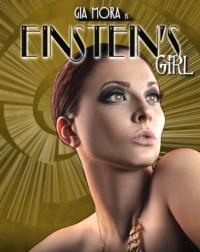
This past weekend, triple threat theatrical talent Gia Mora returned to the DC metro area with her one woman cabaret act, interestingly titled Einstein’s Girl. Local theatregoers who have frequented the likes of Signature Theatre, Metro Stage, Ford’s Theatre, the Kennedy Center, Arena Stage and more likely know Ms. Mora for her strong, high soprano belt, and equally strong dancing and acting skills. It’s less likely they know that Gia is a bit of an amateur theoretical physics geek.
Physics and singing? Who would have thought? It’s certainly an unlikely mix of interests yet Ms. Mora beautifully brought these two passions – and more – together in her unique and highly original cabaret, which is making the rounds in venues in California, New York, and the DC area. With it, Ms. Mora delivered a mixture of contemporary patter songs and standards, along with original stories and commentary that explore the science of love in our increasingly interconnected yet lonesome world.
Clearly, the topic of love/romance has served as a foundation for many a cabaret. Though not a completely tired topic – after all it is universally relatable and multi-faceted – it can be met by many a groan for those looking for a cabaret that’s a bit different. Ms. Mora managed the unthinkable here – putting a fresh spin on the subject of love. Melding intellectual thoughts on topics as varied as black holes and supercomputing and devilishly funny commentary on the intersection between American obsession with technology and the search for love with sultry, jazz-infused vocals, she provided a convincing argument for why a cabaret about love/romance might not be so tired after all.
The success of Ms. Mora’s self-penned cabaret (with additional material from Brad Brown) is not only due to her strong thematic structure – though that’s certainly a key ingredient – but also her immediately relatable persona. From the time she appeared on stage to the encore number, she naturally commanded the stage and made one take notice not only when she was singing, but when she relayed her thoughts on the admittedly varied, yet connected subjects with spoken word. Having seen many a cabaret where the ‘in-between-songs’ banter was downright painful and awkward – and left me wondering when the performer would just sing – I am happy to report that there’s very little of that (if any) painfulness in this performance. She was simply charming.
Yet, sing she did. Backed by her equally talented music director on piano, Charlie Barnett, she more than proved her vocal versatility. From comedic, contemporary musical theatre-like numbers such as “Oh, Internet” (Hannah Hart), “I Google You” (Amanda Palmer/Neil Gaiman), and “The Facebook Song” (Kate Miller-Heidke), to more traditional standards like “What a Little Moonlight Can Do” (Harry Woods) and pop-rock numbers like “Fools in Love” (Joe Jackson), Ms. Mora comfortably delivered emotionally on-point vocals with technical precision.
While it would be difficult to point out some highlights, three particular numbers caught my interest for different reasons.
“Glorious Higgs,” (Michael Flanders/Donald Swann with lyrics by Danuta Orlowska), first performed by a bunch of physicists at CERN (a hotbed of physics research in Switzerland), comically considers issues of importance in – of all things – quantum physics. When’s the last time you heard a song about that? This song gave Ms. Mora an opportunity to ‘geek out’ so-to-speak on a subject of interest to her in an accessible way while entertaining the audience members with her playful vocals.
Though more than a few Broadway divas have included John Kander and Fred Ebb’s “The World Goes Round” (from New York, New York) in their respective cabaret acts, I appreciated that Ms. Mora put her own unique vocal spin on this fantastic number. As a result of her unique phrasing, textured vocals, and apparent connection with the lyrics, it was like hearing the song for the first time. She followed up this sensational vocal performance with an emotional take on “Second Star to the Right” (Sammy Fain/Sammy Cahn). This number displayed her quiet and contemplative side and was a perfect ending to her delightful act.
Running Time: About 90 minutes with no intermission. Einstein’s Girl was a one-night-only performance at the Bethesda Blues and Jazz Supper Club – 7719 Wisconsin Avenue in Bethesda, MD – on April 13, 2013. For a listing of Gia Mora’s upcoming performances, visit her website.
This website uses cookies to enhance your experience. Some are essential for site functionality, while others help us analyze and improve your usage experience. Please review your options and make your choice. Your privacy is important to us. You can adjust your cookie settings at any time. You may change your preferences at any time by clicking on the settings button below. Please note that if you choose to disable some types of cookies, it may impact your experience of the site and the services we are able to offer.
Essential cookies and services enable basic functions and are necessary for the proper functioning of the website. These cookies and services do not require user permission.
This category includes all cookies, domains, and services that do not fall into the other specified categories or have not been explicitly categorized.
We value your privacy. Our website uses cookies to enhance your browsing experience and ensure the site functions properly. By continuing to use this site, you acknowledge and accept our use of cookies.