
I recently had the pleasure of writing music for first-time filmmakers Caitlin Carroll and Brad Forder for their documentary on Washington DC’s murals, Painted City. It is an unusual look at the amazing artworks that appear on walls all over this beautiful city, as seen through the eyes of Perry Frank, a historian whose mission is to document as many of these as she can before they either self-destruct or are laid to waste via urban revitalization.
Two things made this a particularly fun project for me:
1. I got to use classic go-go grooves throughout the score. If you’re not familiar, go-go is a style of music unique to Washington DC that incorporates elements of funk, R&B and hip-hop. It hit its highest spot nationally with Chuck Brown’s 1978 hit “Bustin’ Loose,” but here in the DMV it’s still going strong.
2. I got to record Vince McCool, one of my favorite trumpet players. His playing is something of a throwback—he reminds me of Al Hirt, Jonah Jones and Louis Armstrong. I never miss a chance to record with him.
– Charlie's Blog –
So many clarinets…
I re-arranged my symphonic composition, Postcards from the West, for symphonic wind ensemble. This is my first foray into the world of wind ensemble music—and I love it. It think this might be the most exciting area of composition that is happening the US right now. When I took on this arranging challenge, my first thought was “What will I do with all those clarinets?” But after a week spent (mentally) in the middle of that lovely bunch of reeds, I ended up thinking that maybe one can’t have too many clarinets. The fact that most wind ensembles exist in colleges means a composer can also feel free to write for extraordinarily large and weird percussion set-ups. Most colleges will have full concert marimbas, chimes, lots of timpani etc. These are elements that I am usually very careful about including in my orchestral writing, because they often require rentals and cartage fees that the orchestra must underwrite. I’ll never abandon orchestral composition, but I must admit that writing for wind ensemble felt liberating in a way. I feel certain I’ll turn to it again soon. If you’re curious, you can find the score and synth realizations here.
The dividing line
I don’t teach for a living and I’m not a student (except in the interest of improving my chili recipe), but I still organize my life in semesters. Maybe you do too. For me, it’s a good way to divide up the year. One 12- to 14-week period seems to be just enough time to write one large(ish) piece of music, score a few films, write two or three songs for my jazz band, and acquire perhaps one new skill. This semester, that new skill was learning to play the ukulele. I had been hearing the Hawaiian instrument on the radio and TV a lot, and now I have this wonderful sound in my quiver of musical arrows. Of course, if I need a master uke player for a recording, I will still hire one, but for a few chords in a pinch, I’ll do. If you divide your years the way I do, I hope you had a fruitful fall semester and that you’ve got big plans for the spring.
Retablos
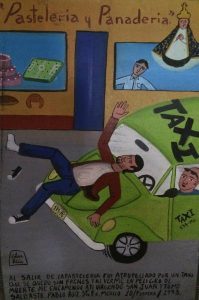 One of my favorite museums is the American Visionary Art Museum in Baltimore, which features amazing works by self-taught artists. Years ago, I brought a bit of that museum home (via its gift shop) in the form of several retablos. These are paintings, mostly from Mexico, each commissioned by someone who has had a brush with death and wants to honor the saint who saved them—often the Virgin of Guadalupe. Their messages are both dramatic and heartfelt.
I recently received a grant to write and record a piece for strings, harp, and percussion with Latin rhythms. When I sat down to write, I took inspiration from these moments of danger on my walls—and from these life-saving saints. I’m pleased to say that the piece is now written. Naturally, I called it Retablos. It’s a 20-minute work in three movements, which are called “Songo,” “Fandango,” and “Cumbia.”
The most challenging aspect of this piece, for me, was the dialog between the harp and the vibraphone. My worry was that the sound and the effect of the two instruments was too similar in timbre and likely to get lost in each other’s sonorities. Luckily, I was able to figure out a way to use that to my advantage. I gave the vibes and the harp a duet section in the middle of each of the movements. I feel very fortunate that there is already a performance planned for this work. The redoubtable David Fanning, conductor of the National String Symphonia, has decided to premiere Retablos in 2017. If you’d like to hear it in the meantime, you can find a synth version, along with PDFs of the score, here.
Rethinking Christmas carols
I heard my first Christmas carol of the year on the speakers at Home Depot before Thanksgiving. Ugh, thought I. But I am probably like a lot of us…conflicted about these chestnuts. If you examine the traditional carols one by one, they are usually pretty good hymns—well crafted and perfectly seasonal. Too bad we get so sick of them. And yet we need them, and not just to make a living as musicians during the season the public wants to hear them. We need them for how they connect us through the years, both with our younger selves and with carolers who have gone before. This week, my band Chaise Lounge will perform our annual Christmas show, with tunes from our Christmas album. One song we always play is “Good King Wenceslas.” It is a sci-fi-tale of the Duke of Bohemia in the 13th century, who leaves heated footprints in the snow as he travels on foot to give alms to a peasant. The melody might be Finnish from the 1600’s. The version we usually sing dates from the mid-19th century. What is astonishing to me is how the fiery silver nugget of wonder in this song burns its way through the centuries to have fresh meaning every time it’s sung. That is some powerful Christmas hoodoo, my friend. If you’re in the DC area, I hope you’ll consider coming to our show at Blues Alley. And if you’re by chance planning a holiday pops concert for a future season, drop me a line and I can tell you about our orchestral arrangements.
Thoughts on Stravinsky
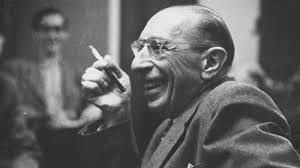 I recently re-read the last of Robert Craft and Igor Stravinsky’s famous collaborative books, Retrospectives and Conclusion. It was published in 1969. That might have the the year I first read it. There are not many people who are more inspiring to me than Igor Stravinsky. His catalog of works is huge, and I think I like everything he wrote. His work from a hundred years ago still seems fresh and innovative. He was invariably himself, and seemed to be immune to trends and vagaries of the music business. As the poet Ezra Pound said of art more generally, Stravinsky’s music is “news that stays news.” And I admire how incisively he spoke of others’ work. Here he is in a 1966 interview, talking about Charles Ives: “[He] was exploring the 1960s during the heyday of Strauss and Debussy. Polytonality; atonality; tone clusters; perspectivistic effects; chance; statistical composition; permutation; add-a-part, practical-joke, and improvisatory music: these were Ives’ discoveries a half-century ago as he quietly set about devouring the contemporary cake before the rest of us even found a seat at the same table.” Who speaks like this? Who can so eloquently analyze another composer on the fly? Like so much of his music, Stravinsky’s take on Ives is important, profound and funny all at the same time. Love this guy.
In Praise of Barns
 Over the summer my jazz band, Chaise Lounge, played in a classically beautiful barn in Vermont. I also heard a wonderful chamber music performance at a barn in Damariscotta, Maine. And now that I’m back in the DMV (a local nickname for the District of Columbia and its Maryland and Virginia suburbs) I’m looking forward to playing at the granddaddy of all barns, The Barns at Wolf Trap in Vienna, Virginia. It must be the lack or parallel walls, or maybe the warm, non-reflective acoustic properties of the wood that makes playing at a properly retrofitted barn feel like playing inside a big guitar. I think it is wonderful that so many of these 18th- and 19th-century structures have been repurposed as music venues. Our Wolf Trap show is on Friday, October 14th. If you are in the neighborhood, please come by.
A Latin melange
I don’t have to tell you that the state of arts funding in much of the US is dismal. That’s why I feel particularly fortunate to live in Montgomery County, Maryland, a jurisdiction that supports both mainstream and esoteric artistic endeavors. I was recently awarded a county grant to write and produce a new chamber work for strings, harp and percussion. The piece I have in mind will incorporate Latin rhythms, in honor of the county’s booming population of immigrants from Central and South America.
Postcards from the West
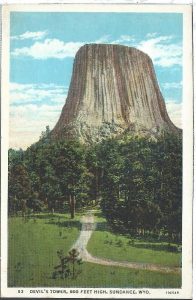 After eight months of work, I have just finished writing a big orchestral piece called Postcards from the West. Total running time, about 43 minutes. At first, the piece’s subject was pretty high-concept. I started out to write a four-movement work about the four states of matter: solid, liquid, gas, and (don’t forget) plasma. But it was tough going. Maybe it comes from all the films I’ve scored, but I tend to work better when I have images in my head as I write. I started poking around the internet for pictures to inspire me and settled on four vintage postcards, each representing to me one of the four states of matter. Unexpectedly, all four images came from the American West, and my way forward became clear. Now the piece is finished, and I am hoping to find an orchestra to premiere this beast. I welcome all thoughts on this matter. Please contact me via postcard. If you’d like to hear or read the piece, you can find PDFs of the score and hear MP3s of a synth realization here.
Where High and Blue Meet
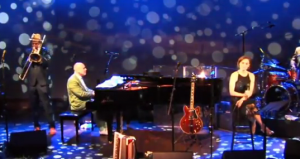 You never know where your next idea will come from. Not long ago, my jazz band, Chaise Lounge, was playing at the funky and highly regarded venue The Rooster’s Wife in Aberdeen, North Carolina. Much of the charm of this theater comes from its owner, Janet Kenworthy, who lodges and feeds touring bands with exquisite Southern hospitality. After sound check, Janet gave us directions to her house: “Walk out this door, turn right on High Street, then walk up to Blue Street and it’s right there.” “OK,” I repeated, “You’re at the corner of High and Blue.” There was a weird silence in the air, and after the perfect pause, our bass player, Pete Ostle, said meaningfully, “Man, I’ve been there.”
How could this not be the next song in what singer Marilyn Older refers to as our “scorned-woman-slumped-over-bar catalog”? When we got home, I put pencil to staff paper and came up with a new song named after the intersection—and the mental state. Here’s a video of us performing it last week at our favorite DC supper club, The Hamilton: “The Corner of High and Blue.”