
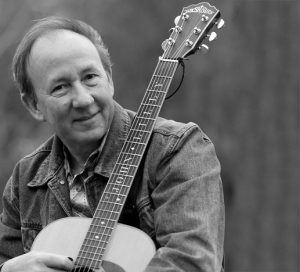
 For the past few months I have been producing bits and pieces of country artist John Lilly’s State Song Project. He has written songs about twelve U.S. states and gotten a patchwork of grants and Kickstarter funds to cover the cost of recording and producing them. His songs seem to me to be the direct descendants of Hank Williams songs: forthright, tuneful, and lyrically solid. Last month we recorded “Mississippi” with the Chaise Lounge rhythm section, a blistering horn section, and three gospel backup singers. Next up will be his anthem to his home state, “The Hills of West Virginia.” When I first heard this song, it reminded me of a rather formal composition that might have been performed in a park gazebo in 1910. John was amazingly agreeable to my suggestion to orchestrate the piece for cornet, French horn, euphonium, tuba, background singers and a rhythm section of frailing banjo, guitar, and double bass. In a few weeks, we’ll go into the studio—and 100+ years back in time.
– Charlie's Blog –
The Future is Now
 Last week I produced a string quartet recording in Tel Aviv…from my home near Washington DC. I’d written the quartet as a sort of reverse overture for an upcoming film, An Open Door. The score will be for full orchestra, but this condensed ten-minute work contains all the major themes. Of course the compositional trick was to write idiomatic string parts for melodies that I’ve imagined for French horn or oboe, along with a full string section, brass, woodwinds, percussion section, etc. The practical trick—a kind of 21st century magic—was to oversee the recording without actually being there.
The onsite engineer and I managed the second trick via Facetime on our phones. Barack gave me a quick tour of the space and of each microphone he was using. I met the members of the quartet, with first violinist, Hagai Shaham translating between Hebrew and English. Maybe you have worked this way before, but it was my first experience with virtual audio production, and I’m now hooked. Though I unfortunately wasn’t able to travel to the session due to other obligations, I was able to get the performance I was hoping for from the quartet. Futurists have been predicting the advent of videophones since I was a little kid. I can’t believe the future is finally here.
A Theme for Remembrance
As a rule, film music doesn’t make particularly good concert music. There are exceptions, of course—much of Bernard Herrmann’s work translates beautifully to the concert hall—but mostly, nah. And conversely, not much serious concert music makes for a workable film score. So I usually try to keep these two areas of endeavor separate in my own work. But I am headed into a ticklish situation in this regard. Director Sonny Izon will be traveling to Israel shortly to record a string quartet version of my theme for his next documentary, An Open Door. Part of the film involves a luthier in Jerusalem named Amnon Weinstein who restores violins that were played by European Jews in the camps and ghettos of the Holocaust. With his craft, he seeks to give these lost legions back their voices. Sonny will record the theme in Israel using these instruments, and later on I’ll also help make a live recording of the same music at a concentration camp in Germany. Writing this music, writing an interesting string quartet that can possibly work as part of a film score, has been a puzzle for me to solve, but one well worth the artistic risk.
Sweet Second Thoughts
When I was a kid, I loathed the sweet, syrupy sound of Nelson Riddle’s Frank Sinatra arrangements. But one of the perks of growing up is that you get to change your mind about things, and this is one area where I have realized Nelson was right and I was wrong. Next week, I will be recording a few lush string arrangements for vocalist Dick Kaufmann, and I noticed while I was arranging these tunes how indebted I am to Riddle’s classic work. Writing the string parts for “Stars Fell on Alabama,” “What the World Needs Now,” and “I Get a Kick Out of You” was a textural challenge. Those swooping violin lines and close harmonies on top of a simple 2-beat rhythm section take an enormous amount of time to get just right—unless maybe you are Nelson Riddle. But I am happy to be here in his shadow.
In the Swim
I swim every day. And I’m sure every day it looks exactly the same to the lifeguard, yet each time it’s a drastically different experience for me. The details of a stroke change in minuscule ways: where your hand enters the water, how much your body rotates on its axis, how high your elbow stays on the recovery, etc. But I can always tell instantly whether my workout is flowing or not. It’s the same with the piano. Every day, I play the same scales that I have played for fifty years. Some days they feel great. Some days I could swear that I had never seen a piano before. But to the casual set of ears off in the kitchen, I sound exactly the same. The difference between a good-feeling warm up and a miserable one is basically inaudible. As musicians, we choose to live in a world where we grade ourselves harshly on the smallest things. It is a special interior hell, but I wouldn’t trade it for anything. I feel lucky to have an inner sense governing the tiny but all-important gradations in performance. And, unlike with swimming, where I sincerely doubt that I will ever equal my teenage times, we actually can practice music and get better our whole lives. As Pablo Casals famously said when asked why he continued to practice at age 92, “I think I’m starting to see an improvement.”
Fanfare for the Open Road
I recently completed a challenging commission. Maestro Pat Miles asked me to write a fanfare for his student orchestra at the University of Wisconsin, Stevens Point. The occasion is his upcoming retirement after umpty-ump years of teaching horn players and building the orchestral program into its current formidable state. (Pat plans to stay on as conductor of the Central Wisconsin Symphony Orchestra.) It is hard for me to write music without having a picture in my head, and I had a tough time envisioning what a retirement looks like. But then I remembered the large photo of Maestro Miles that hangs in the Central Wisconsin Symphony Orchestra concert hall along with portraits of some of the section leaders. He’s wearing a proper tuxedo with tails, carrying a baton, and perched on the ultra-light racing bicycle he rides as a serious racer. That image of Pat is all I needed. Like that photograph, music can be deeply serious and light-hearted at the same time. The two-minute piece is scheduled for premiere in May. You can download the score and an MP3 of the synth track here.
In Praise of Non-Broadcast
Young composers often ask me how to break into writing for film and television. One kind of work I advise them to pursue is a type I still enjoy doing myself: “industrials,” or non-broadcast films for corporate or nonprofit clients. I recently scored a piece on ethics for the Educational Testing Service; an exhibit piece for the Roosevelt Institute in Hyde Park, New York; and a labor of love by the director Cressandra Thibodeaux about a pair of art patrons in Houston, Texas.
The quality of these films is often very high. The directors are often very good. And, surprisingly, the music budget is sometimes bigger than it is on broadcast TV shows, which means more leeway to hire musicians for recording sessions. The trick to writing a successful score for these films is staying out of the way of the words. The right score will generally not have a prominent melody. It will be all about texture and pace. Films like these are a great training ground for any composer.
Twelveness
A few months ago, a friend told me a curious fact: In 1936, George Gershwin had a standing tennis date in Los Angeles with Arnold Schoenberg. Can you imagine a more incongruous pair? The seemingly effortless crowd pleaser, Gershwin, up against the cerebral Teutonic composer who probably would have been horrified if, during a performance of one of his challenging atonal works, the crowd had accidentally been pleased. I couldn’t get these two out of my mind, so while I was on vacation recently, I wrote a play about them. It’s not even a musical, though there’s incidental music in the script. The play is called Twelveness, after Schoenberg’s 12-tone serial technique, natch. It hasn’t hit Broadway yet…or off-Broadway…or off-off-Broadway…but stay tuned.
This Exists
I just finished scoring an unusual documentary by director David Hanrahan. The film, called This Exists, is about a Brazilian spiritual leader and teacher named Prem Baba. It was a novel project for me—a biography combined with something of a feature-length meditation. The music is incredibly spare: a combination of solo piano, solo cello, and Tibetan singing bowls. The film also features tracks from Ashana, a new-age singer from Arizona. This score was an exercise in restraint for me. At every dramatic moment, I had to dial everything back to the emotional level of Prem Baba’s quiet message and let the tranquility of the scene resonate.
Listening to Paintings
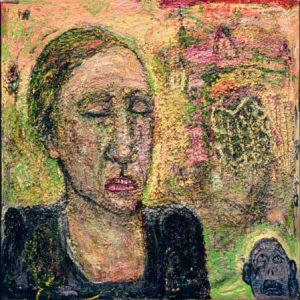 I recently completed the score for a documentary about the dark and quixotic artist Miriam Beerman, who is 91 years old. The film, Miriam Beerman: Expressing the Chaos, is a passion project by the director Jonathan Gruber. It was an incredible challenge to match the intensity of this under-appreciated painter’s vivid canvases while finding a way to illuminate her calm personality. To get this feeling of serenity within chaos, I chose a palette of essentially four instruments; piano, cello, vibes, and percussion—including the high keening sound of bowed crotales.