by Modern Songbook Records | May 23, 2015 | Charlie's Blog, News
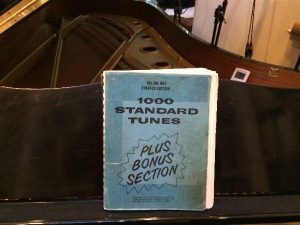 I would love to know where this fake book came from. Who compiled it, and who pressed it? I distinctly remember buying my first copy of this book. It was at a music store in Easton, Pennsylvania, where I went to high school. After I had bought dozens of pieces of sheet music one by one, the store owner discreetly took me aside and said, “You might be interested in one of these.” It was the blue 1000 Standard Tunes (Chicago edition). It saved my life. And in some ways made a large part of my career as a gigging musician possible.
But it was a completely illegal book! There is no publisher listed, or any information at all, for that matter. The songs are arranged by tempo and style. There are indeed a thousand of them, and nearly every one helped me along the way. “Daddy’s Little Girl” got me through hundreds of wedding receptions. And that weird E7 chord that is so perfect in “Georgia On My Mind”—how long would I have played that wrong without this trusty book? The list of songs in the table of contents is the very definition of the Great American Songbook.
Sometime in the 1970’s, I became aware of The Real Book and its many iterations thereafter. Compiled by students at the Berklee College of Music, it was supposed to be so much hipper than the grimy fake book I schlepped from gig to gig. But the reality is that the most of the songs in The Real Book are forgettable jazz numbers, and even the standards have been re-harmonized, taking all the interesting quirky changes out of the beautifully written originals. It is a pity that so many musicians are learning these songs via “Real Book changes” rather than from the original harmonies.
As a rule, I argue for all songwriters’ rights. I hate the larcenous Spotify and rail against illegal downloading. But for some reason, this little blue bit of thievery holds a warm place in my heart. Thank you to whoever put this thing together and made a world of great music available to me.
by Modern Songbook Records | May 1, 2015 | Charlie's Blog, News
I am just now finishing the score for a PBS film for director Noel “Sonny” Izon. It is called Choc’late Soldiers from the USA, after a World War II-era Australian song. Sonny got some great interviews with African American World War II vets, who told him about the astonishing experience of serving in countries like England, where they were treated with the same hospitality—and where they had the same rights—as their white countrymen. Maybe the most interesting insight in this terrific film is the suggestion that these soldiers’ experience of equality abroad is what later sparked the Civil Rights movement at home. The score features strings and a fabulous solo trumpet performance by the very talented Vince McCool.
by Modern Songbook Records | Apr 15, 2015 | Charlie's Blog, News
My jazz band, Chaise Lounge, has been on the road a lot lately, so we’re looking forward to April 17, when we’ll play a hometown show at the elegant supper club The Hamilton in Washington DC. We have just finished recording and mixing a new CD that will be called Gin Fizz Fandango. And not coincidentally, our resident mixologist, bassist Pete Ostle, has invented a “gin fizz fandango” cocktail that will be served at the Hamilton gig. Naturally, the band has scheduled a tasting of this signature drink—some purists might call it a “rehearsal” but we know better. If you’re in the area next Friday, I hope you can come out to hear our new music and sample the new drink.
by Modern Songbook Records | Apr 15, 2015 | Charlie's Blog, News
On May 9, Maestra Victoria Gau and her Takoma Ensemble will perform my piece The Fireman’s Carnival. This five-movement suite for strings, harp, and clarinet was inspired by one night in a small town in Pennsylvania. On that night, my four sisters and I were allowed to ride our bicycles to the Riverside Fireman’s Carnival, which had magically appeared the previous day. Where there had been an empty field there was now a Tilt-a Whirl, a tiny Ferris wheel, and a small midway of games. We stayed late into the night and rode home with a full moon shining through the fog. Many years later, I tried to capture this evanescent adventure in music. Though I recorded the piece in 2009, it has never been played live before now. The clarinet soloist will be Ben Redwine, a spectacular player. I can’t wait to hear what he brings to this strange creation.
At that concert, the ensemble will also premiere a three-movement piece called Three Completely Workable Perpetual Motion Devices that I wrote especially for them. This was my attempt to write like Vivaldi and test a string section’s ability to play at terrifically bright tempos. While I am fascinated with fake machines that claim impossible results—like the perpetual motion devices of the 19th century—I hope this piece is a mechanical invention that actually works.
The concert will be held at the Episcopal Church of the Ascension in Silver Spring, Maryland. It is called “Barnett and the Brits” after me and the other two fellows on the program: Henry Purcell and Benjamin Britten.
by Modern Songbook Records | Mar 31, 2015 | Charlie's Blog, News
My main instruments are piano and guitar. Sure, when I was in my twenties, I played enough bluegrass fiddle to get by, but I long ago decided to leave the string instruments to the pros. When I was in the studio on Monday with a string ensemble, recording a film score I’d written, I realized just how much I have come to rely on the subtle expertise that good string players bring to a session. The concertmaster, Teri Lazar, knew exactly what to tell everyone about articulations, bowing, and dynamics, and she said it with such perfect string-player shorthand that I almost forgot to be amazed at how her instructions made the session go perfectly. Tools like Sibelius may make it easy for people like me to put dots on a page and write “Violin I” at the top of it, but string music can’t come alive without the depth of wisdom that resides in the hands, eyes, and hearts of the players. Fiddlers, I love you. And to anyone else who lends their years of practice and expertise to help create and improve on the music in someone else’s head: I love you too.